Adaptive Traffic Signal Control: Sensors, Algorithms, Operations, and Deployment Limits
Adaptive traffic signal control can respond to changing traffic conditions, but its value depends on reliable detection, communications, operations, and corridor conditions.
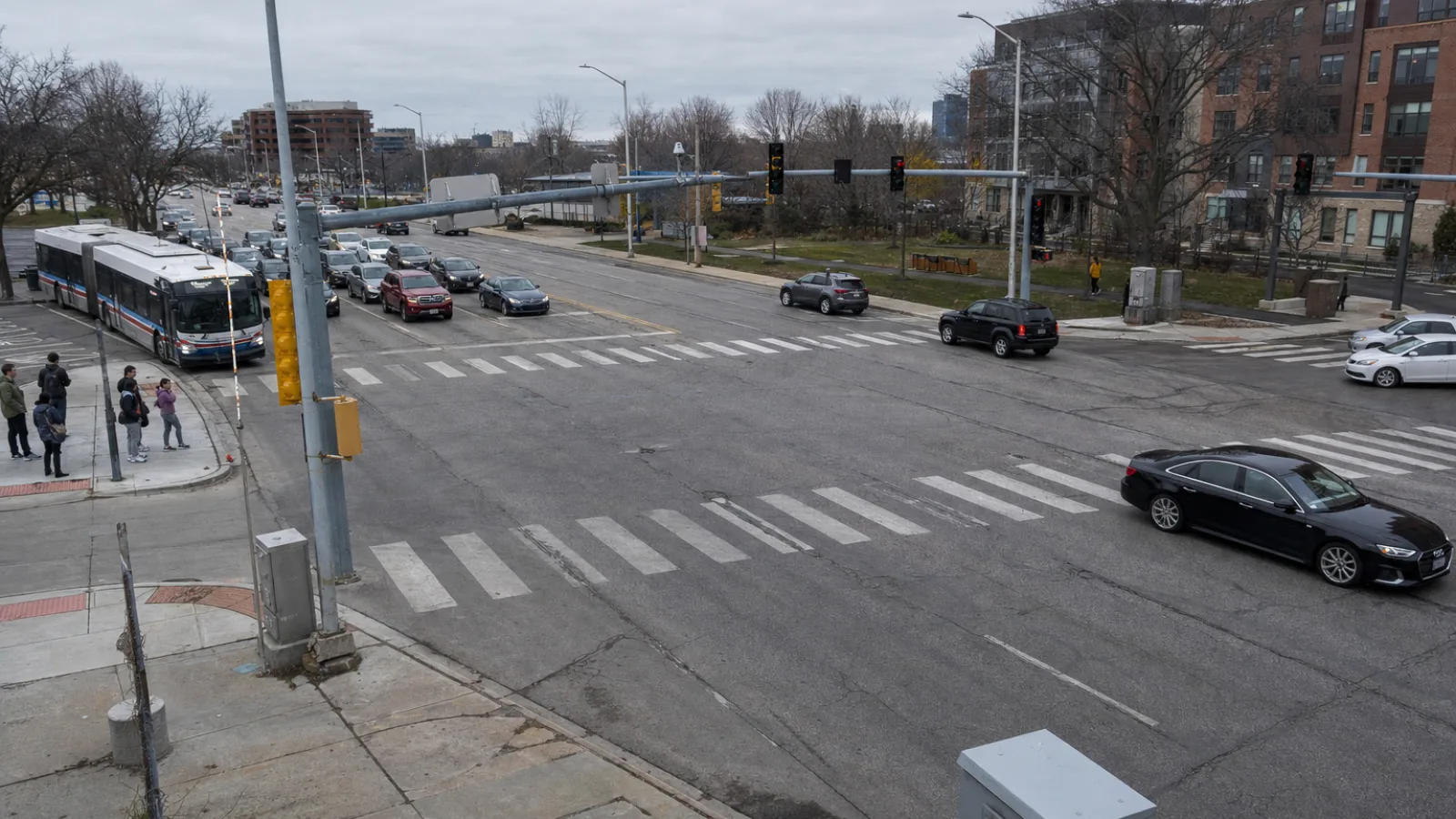
Adaptive traffic signal control continuously adjusts signal timing in response to changing traffic conditions. Instead of relying only on a static schedule, the system uses field data, traffic models, and optimization rules to revise how green time, cycle lengths, and coordination are allocated across a corridor or network.
For agencies evaluating adaptive traffic signal control solutions, the central question is not whether the technology sounds advanced. It is whether available data, communications, field equipment, operations capability, and corridor conditions justify the added complexity. Adaptive control can improve operations in suitable environments, but it is not a universal replacement for well-engineered fixed-time, actuated, or coordinated plans.
Key Takeaways
- Adaptive control uses ongoing traffic observations to revise signal timing within agency-defined safety and coordination limits.
- Detection quality, communications reliability, controller compatibility, and maintenance capacity often determine results more than the optimization algorithm alone.
- Adaptive traffic signals are most useful where demand varies materially and corridor performance can be measured across several intersections.
- Fixed-time, actuated, coordinated, and hybrid strategies may be more appropriate where traffic is stable, infrastructure is weak, or operational staffing is limited.
- Success should be judged using baseline comparisons that include delay, queues, reliability, transit and pedestrian effects, maintenance burden, and resilience.
What Is Adaptive Traffic Signal Control?
Fixed-time control operates from scheduled timing plans developed for expected traffic patterns. A plan may vary by time of day, weekday, season, or special event, but it does not continuously infer current conditions from live observations.
Actuated signal control responds locally to vehicle or pedestrian calls. Detectors can extend a green phase, omit an unneeded phase, or call a movement when demand is present. Its decisions generally remain within configured minimums, maximums, phase sequences, and coordination constraints.
Signal coordination links multiple intersections through common cycle lengths and offsets. An offset is the time relationship between neighboring signals, allowing traffic to progress along an arterial. Coordination can be fixed or adjusted by a higher-level control system.
Adaptive traffic signal control generally combines broader and more continuous data with an optimization process. Rather than independently reacting at one intersection, it typically evaluates a corridor or network over a moving time horizon. Common objectives include reducing delay, improving progression, managing queues, supporting transit or emergency operations, and maintaining acceptable service among competing approaches.
The system does not freely change every parameter. Safety requirements, pedestrian minimums, clearance intervals, phase rules, controller capabilities, agency policies, and downstream storage limits constrain the available choices.
How an Adaptive Signal System Works
1. Detection and data collection
Adaptive operation begins with observations of traffic and road-user demand. Potential sources include inductive loops, video detection, radar, lidar, magnetometers, Bluetooth or other probe data, connected-vehicle inputs, pedestrian detectors, and feeds from transit or emergency-vehicle systems.
Different technologies provide different measurements. A loop may detect occupancy and vehicle passage at a defined point. Video or radar may estimate volume, speed, lane use, turning movements, and queue conditions. Probe data can indicate travel time and corridor speed between intersections but may not identify every approach or movement. Pedestrian and transit feeds provide information that vehicle-only detection cannot.
Practical limitations matter. Video can be affected by occlusion, glare, darkness, weather, dirty lenses, and construction changes. Radar can require careful placement and calibration to distinguish lanes or stationary queues. Loops and magnetometers can fail because of pavement work, wiring faults, or detector-card problems. Probe and connected-vehicle data may have coverage gaps or latency. Agencies must also address privacy, data retention, calibration, false detections, and maintenance access.
2. State estimation and traffic modeling
Raw observations are not the same as a complete description of traffic. The system converts readings into an estimated state: current volumes, occupancy, speeds, queues, arrivals, turning demand, and likely conditions between detection points.
Estimation is necessary because data can be delayed, noisy, incomplete, or contradictory. A queue may extend beyond a detector. A blocked camera may undercount one lane. A detector may report occupancy without identifying whether vehicles are moving or stopped. The system therefore relies on traffic models, historical patterns, intersection geometry, phase configuration, and assumptions about arrivals.
Accurate digital records are essential. Lane assignments, turn restrictions, detector locations, phase sequences, pedestrian timings, storage lengths, and downstream bottlenecks must match field conditions. An algorithm working from incorrect geometry can produce technically consistent but operationally poor decisions.
3. Optimization and timing decisions
Optimization may revise cycle length, green splits, offsets, phase sequence, and coordination relationships. A split is the portion of the cycle assigned to a movement or phase; an offset is the timing relationship between adjacent intersections. Minimum and maximum green times, yellow and all-red clearance intervals, pedestrian service requirements, and transit or emergency priorities limit the feasible solution.
Most systems use rolling-horizon optimization. They evaluate recent observations and near-term conditions, select a permissible timing response, implement it, and then reassess using new data. This allows the system to respond to directional commuter flow, an incident, a construction detour, or an event without waiting for the next scheduled plan.
Local optimization focuses on an individual intersection. Corridor or network optimization considers how one decision affects progression, queues, side-street delay, downstream storage, transit, pedestrians, and neighboring intersections. A locally efficient change can be harmful if it shifts a queue into a downstream bottleneck.
4. Controller implementation and feedback
After optimization, recommended timing changes or timing parameters are transmitted to field controllers, edge computers, or central traffic-management software, depending on the system architecture. The controller remains responsible for executing permitted signal operations and safety intervals.
Operators need visibility into what changed, why it changed, and whether the field response matched the recommendation. Monitoring should identify failed communications, abnormal detector readings, timing-plan conflicts, controller alarms, and unexpected queues. Manual overrides and scheduled fallback plans are important during incidents, maintenance, special events, or system faults.
A properly designed system should continue safely when detection or communications fail. Depending on the equipment, that may mean using a local adaptive process, a stored schedule, or a conventional coordinated plan. The fallback must be configured, documented, and tested rather than assumed.
Core Infrastructure and Technology Requirements
An adaptive installation typically involves signal controllers, cabinets, detection equipment, field wiring, communications, edge computing, central software, time synchronization, power, and maintenance access. The exact architecture varies, but every component affects operational reliability.
Communications may use fiber, cellular service, radio, or other agency-approved networks. Fiber can provide substantial capacity where it is available, while cellular or radio may be practical for dispersed locations. The relevant question is whether the network provides adequate availability, latency, security, coverage, and lifecycle support for the intended control strategy.
Older controllers, inconsistent firmware, incomplete cabinet documentation, unreliable power, inadequate bandwidth, or incompatible interfaces can limit deployment. Modernization may require cabinet rewiring, detector replacement, communications upgrades, controller configuration, or field verification before adaptive operation is practical.
Integration can extend to a traffic management center, maintenance-management system, transit-management platform, emergency-preemption equipment, incident-management tools, and traveler-information systems. Integration improves situational awareness but also increases the number of interfaces that must be governed, secured, and maintained.
Adaptive Traffic Signal Control Versus Other Approaches
| Control approach | Primary input | Strengths | Limitations |
|---|---|---|---|
| Fixed-time | Scheduled plans and historical demand | Predictable, transparent, and relatively simple to maintain | Can respond poorly to unusual or rapidly changing demand |
| Actuated | Local vehicle and pedestrian calls | Reduces unnecessary green time and serves detected demand | Usually makes local decisions within configured limits |
| Coordinated | Common cycle, offsets, and corridor timing plans | Supports predictable arterial progression | May be less responsive when demand or queues change materially |
| Adaptive | Continuous traffic observations and modeled conditions | Can revise coordination and allocation as conditions change | Requires dependable data, communications, governance, and maintenance |
Adaptive control is not automatically superior. Fixed-time plans can be effective where demand follows stable patterns. Actuated control may be sufficient at isolated or lightly coordinated intersections. Conventional coordination may perform well on a stable arterial after careful engineering.
Hybrid strategies are often practical. An agency may use scheduled plans during predictable periods and adaptive operation during peak variability, construction, special events, or incident recovery. This approach can preserve a known operating mode while applying adaptive capability where it has the greatest operational value.
Where Adaptive Traffic Signal Control Can Add Value
Adaptive traffic signals are most likely to add value where demand varies enough to make static plans inefficient and where intersections are sufficiently connected for network effects to matter. Candidate conditions can include directional commuter flows, closely spaced intersections, recurring but variable congestion, construction detours, seasonal demand, special events, and corridors with measurable progression problems.
Potential operational benefits include fewer unnecessary stops, better use of available green time, more responsive queue management, improved coordination during unusual conditions, and greater visibility for traffic management center operators. These are operational possibilities, not guaranteed outcomes. The effect depends on the quality of detection, the objective selected, the available storage, and the behavior of traffic outside the signal system.
Deployment Limits and Common Failure Modes
Data quality and detection coverage
Inaccurate counts, blocked sensors, poor lane attribution, timing errors, and unobserved queues can lead to poor decisions. A system cannot optimize demand it does not measure reliably. Detection should be audited during representative conditions, including nighttime, adverse weather where relevant, heavy queues, pedestrian activity, and construction-related changes.
Network and corridor constraints
Turn restrictions, short blocks, limited storage, railroad crossings, pedestrian minimums, transit priorities, emergency preemption, downstream bottlenecks, and competing objectives constrain optimization. A signal system cannot solve a capacity or geometric problem that occurs outside the signalized intersection. Adding green time to one approach may simply move the queue to the next restriction.
Operations and institutional readiness
Adaptive operation requires trained staff, timing-plan governance, interagency coordination, documentation, procurement discipline, and regular performance review. Operators need to understand both automated decisions and the circumstances requiring intervention. Without ownership and training, the system can become difficult to diagnose or gradually drift from field conditions.
Maintenance and lifecycle costs
Total cost of ownership includes sensor cleaning and recalibration, controller and communications maintenance, software support, replacement parts, cybersecurity updates, field verification, configuration management, and data-quality audits. A lower initial equipment price may not represent a lower lifecycle cost if maintenance access, licensing, training, or integration requirements are substantial.
Operations, Monitoring, and Performance Measurement
Agencies should define objectives before selecting an algorithm. Possible objectives include reducing person delay, improving travel-time reliability, limiting queue spillback, supporting transit, reducing unnecessary stops, preserving pedestrian service, improving incident response, or balancing performance across approaches.
Useful traffic signal performance measures include travel time, person delay, number of stops, arrival-on-green, throughput, queue length, queue spillback, reliability, transit delay, pedestrian service, operator interventions, equipment availability, and user complaints. No single measure captures the full effect of a corridor strategy.
Before-and-after comparisons should use representative operating conditions and account for seasonality, weather, construction, demand changes, incidents, and special events. Dashboards can provide routine visibility, while alerts, event logs, manual observations, probe data, and periodic engineering reviews help explain why performance changed.
Evaluation should avoid optimizing one intersection or one direction at the expense of network performance. A modest increase in delay on one approach may be acceptable if it prevents severe downstream spillback, improves person movement, or protects transit and pedestrian operations. Those trade-offs should be explicit rather than hidden inside a performance score.
Cybersecurity and Resilience Considerations
Connected signal systems expand the operational technology attack surface. They also create practical risks from incorrect configurations, unauthorized access, software defects, and loss of communications. Defensive planning should begin with an inventory of controllers, cabinets, detection devices, network connections, software, and vendor access paths.
Useful controls include network segmentation, least-privilege access, multifactor authentication where appropriate, secure remote access, patch management, logging, protected backups, vendor access controls, and documented incident response. Agencies should know how to isolate affected equipment and restore approved configurations.
Resilience also means planning for communications outages, sensor failures, power interruptions, incorrect time synchronization, and corrupted configuration files. Fallback procedures should be tested under controlled conditions, with clear responsibilities for operators, maintenance staff, system integrators, and vendors.
How to Evaluate an Adaptive Signal Control Project
- Define objectives and constraints. Identify the corridor or network problem, affected road users, storage limits, pedestrian and transit requirements, and acceptable trade-offs.
- Audit existing assets. Document controllers, detection, communications, power, cabinet condition, firmware, geometry, timing, and data quality.
- Establish a baseline. Measure representative travel time, delay, queues, stops, reliability, transit effects, and maintenance conditions before changes are made.
- Select a manageable pilot. Choose a corridor with measurable variability, adequate data potential, and complexity that staff can realistically support.
- Specify lifecycle requirements. Address interoperability, cybersecurity, training, maintenance, service levels, fallback operation, data ownership, and configuration management.
- Test progressively. Use simulation, shadow operation, or limited operational modes where appropriate before expanding automated control.
- Measure over a meaningful period. Include different demand patterns and control for construction, weather, incidents, and special events.
- Make an engineering decision. Expand, modify, pause, or retain conventional plans based on measured outcomes and lifecycle capability.
Agencies should ask vendors and integrators whether the system supports existing controllers, how algorithms expose assumptions and constraints, who owns raw and processed data, how manual overrides work, what service levels apply, how software updates are governed, whether performance data can be exported, and how the agency can transition at the end of a contract. These questions are as important as the initial optimization demonstration.
When Fixed-Time or Coordinated Plans May Be Better
Conventional plans may be the better engineering choice where traffic is stable and predictable, detection coverage is weak, communications are unreliable, the network is small or isolated, operations staffing is limited, or pedestrian and transit requirements leave little flexibility. A well-engineered coordinated plan may already perform adequately on a stable arterial.
Retaining fixed-time or actuated operation can be a deliberate decision rather than a rejection of intelligent transportation systems. Agencies may also combine proven fixed plans with adaptive operation only during selected periods or conditions. The appropriate strategy depends on the corridor, not on the novelty of the technology.
Focused FAQ
What is the main difference between adaptive and actuated signal control?
Actuated control responds locally to vehicle or pedestrian calls within configured limits. Adaptive control typically uses broader, continuous data and optimization to revise coordination or timing across a corridor or network.
Does adaptive traffic signal control eliminate congestion?
No. It can improve signal operations under suitable conditions, but it cannot remove travel demand, add roadway capacity, eliminate bottlenecks, or resolve every queue caused by geometry or downstream constraints.
What sensors are required?
Requirements vary by platform and objective. Loops, video, radar, lidar, probe data, connected-vehicle inputs, or combinations may be used. Reliable coverage, calibration, maintenance, and correct interpretation matter more than choosing one sensor type universally.
How long does deployment take?
Timing depends on asset condition, procurement, communications, detection installation, software integration, testing, training, and evaluation. There is no reliable universal deployment period for every corridor.
Can adaptive signals work during a communications outage?
Properly designed systems should fall back to local or scheduled plans, but resilience depends on controller configuration, edge capability, power, and agency testing. Fallback behavior should be specified and verified before deployment.
How should performance be judged?
Compare defined baseline measures across representative conditions. Include delay, travel time reliability, queues, stops, transit and pedestrian effects, maintenance burden, operator workload, equipment availability, and operational resilience.
Conclusion
Adaptive traffic signal control is an operational system, not simply a software purchase. Its performance depends on detection, state estimation, optimization, communications, field controllers, power, maintenance, cybersecurity, people, and governance working together.
Successful deployment begins with measurable objectives, reliable data, maintainable infrastructure, tested fallback procedures, and realistic expectations about what signals can and cannot solve. Agencies should choose adaptive, fixed-time, actuated, coordinated, or hybrid control based on corridor conditions and lifecycle capability rather than technology novelty.