Construction Robotics: How Bricklaying, Demolition, Welding, and Inspection Robots Are Changing Building Sites
Construction robotics is moving beyond research laboratories into bricklaying, demolition, welding, inspection, and material-handling workflows. This guide explains where these systems deliver practical value, where their limitations remain, and how contractors can adopt them responsibly.
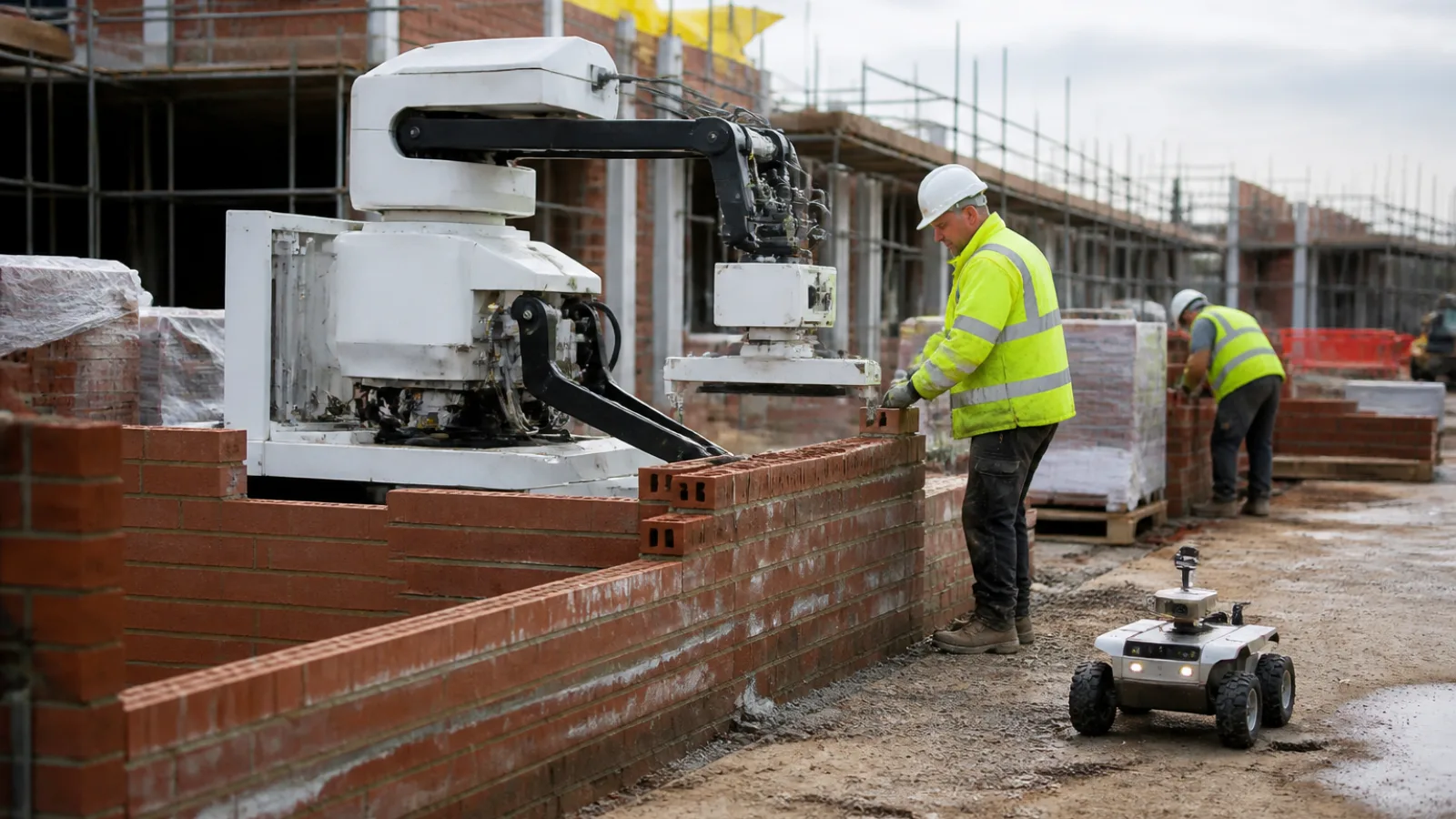
Construction robotics brings programmable machines, sensors, machine vision, and digital models into tasks traditionally performed entirely by people. Contractors, developers, and engineers are evaluating these systems to improve repeatability, reduce exposure to hazardous conditions, address labor constraints, and create more reliable project records.
Applications now include automated masonry, remote-controlled demolition, robotic welding, site inspection, surveying, and machine-assisted material handling. For example, the Hadrian X bricklaying robot demonstrates how digital layout data and automated material placement can be combined for masonry work. The practical question is not whether robots will replace construction teams, but where a machine can perform a defined task safely and consistently while skilled people remain responsible for planning, supervision, quality, and finishing.
What Is Construction Robotics?
Construction robotics is the use of programmable machines to sense, position, manipulate, inspect, or move materials and equipment during construction. A robot may work independently within a controlled area, operate remotely under direct human control, or assist a worker with a specific physical task.
It is useful to distinguish several related terms. Robotics refers to machines that can perform physical actions based on programmed instructions and sensor inputs. Automation is broader and includes software, conveyor systems, machine controls, and other processes that reduce manual intervention. Remote operation means a person controls a machine from a safer or more suitable location. An AI-supported workflow uses algorithms to interpret images, identify patterns, plan sequences, or flag exceptions, but it does not necessarily mean the machine is autonomous.
Most building robots depend on a combination of sensors, cameras, LiDAR, positioning systems, safety scanners, and control software. BIM or CAD data can provide wall layouts, structural geometry, or inspection targets. Connectivity allows information to move between the site, project platforms, and remote supervisors. Human oversight remains essential because construction sites change frequently and digital models do not always reflect actual conditions.
How Robots Are Used on Modern Construction Sites
Bricklaying robots
Automated bricklaying systems typically combine material handling, a robotic arm or positioning mechanism, mortar or adhesive application, and digital layout data. Bricks or blocks are supplied to the machine, placed in a defined sequence, and positioned according to a programmed wall geometry. Depending on the system, a separate process may manage cutting, alignment, or material replenishment.
Hadrian X is a prominent global example of a large-format automated masonry system. It is designed to receive digital building information and place masonry units through a controlled construction process. Its long-reach arrangement and material delivery approach are intended to support rapid wall construction in suitable conditions, although project setup, access, weather, wall geometry, and finishing requirements still determine whether it is practical.
The SAM Bricklaying Robot, developed for use with construction crews, is another example of robotic masonry equipment. Rather than representing a completely independent building operation, systems such as SAM are generally used to automate repetitive placement while workers manage site preparation, materials, layout verification, tooling, mortar conditions, quality checks, and the work that follows masonry placement.
Bricklaying robots are strongest where wall designs are repetitive, work areas are accessible, materials are standardized, and a stable foundation or platform is available. They are less suitable for highly irregular layouts, tight interior spaces, frequent design changes, complex openings, or projects requiring extensive hand finishing. Setup and calibration can also take time, and the robot does not eliminate the need for experienced masons to handle corners, interfaces, corrections, weather-related issues, and quality control.
Robotic demolition
Robotic demolition machines are usually compact, remotely operated tracked units fitted with attachments such as breakers, crushers, drum cutters, grapples, or buckets. An operator controls the machine from outside the immediate hazard zone, often using a remote console or handheld controller. This arrangement is valuable in confined, unstable, contaminated, high-temperature, or heavily dusty areas where placing a person directly beside the work would increase risk.
These machines can break concrete, remove masonry, strip internal structures, and work in locations that are difficult to reach with larger equipment. Water sprays, extraction systems, and controlled work methods may help manage dust. Debris still needs to be sorted, removed, and monitored, and the robot may require frequent attachment changes or repositioning.
Remote operation can reduce exposure to falling material, vibration, noise, and airborne contaminants, but demolition risks do not disappear. Operators and supervisors must understand the structure, identify hidden services, establish exclusion zones, monitor stability, and use stop controls. A remote machine can also create hazards through unexpected movement, loss of visibility, attachment failure, or changing ground conditions.
Robotic welding and fabrication
Robotic welding is most established in controlled fabrication environments, including structural steel production, modular construction, reinforcement fabrication, and repetitive manufacturing. A robotic arm follows a programmed path to create consistent welds on components held in a fixture. The process can be supported by positioners, wire-feed systems, seam tracking, and automated handling.
Programming begins with the joint design, welding procedure, material, and desired sequence. Accurate fixturing is critical because the robot expects parts to be located within defined tolerances. Quality control may include visual inspection, dimensional checks, weld parameter records, and non-destructive testing where required. Robotic systems can improve repeatability, but they cannot compensate for poor preparation, distorted parts, contamination, or incorrect engineering information.
Qualified welders, welding engineers, programmers, fabricators, and inspectors remain necessary. People define procedures, approve parameters, respond to variation, verify results, maintain equipment, and address joints that do not fit the automated pattern. On-site welding is usually more difficult to automate than factory welding because access, weather, geometry, and material conditions vary significantly.
Robotic inspection and site documentation
Inspection robots and robotic data-capture tools use cameras, LiDAR, thermal sensors, positioning equipment, or other instruments to collect information about a building site. Drones can survey roofs, façades, and large areas from the air. Ground robots can move through floors, plant rooms, tunnels, or other areas while recording images and spatial data. A quadruped such as Boston Dynamics Spot can carry inspection sensors and navigate selected environments under remote or supervised control.
These tools can support progress tracking by comparing current conditions with schedules, drawings, or previous scans. They may help identify missing equipment, unprotected edges, access obstructions, water intrusion, temperature anomalies, or deviations from an intended installation. Repeated data capture can also contribute to as-built documentation and handover records.
Inspection robotics does not make professional judgment unnecessary. Images and sensor readings must be interpreted by competent people, and data quality depends on lighting, occlusion, weather, positioning, and the selected sensor. A robot may record an apparent defect without understanding its cause or severity. Human reviewers remain responsible for confirming findings, prioritizing action, and recording decisions.
Autonomous construction equipment and material handling
Some construction technology companies are developing autonomous or semi-autonomous systems for excavation support, grading, material movement, and repetitive machine operations. Built Robotics is an example of a company associated with autonomous construction equipment and machine-control systems. Such systems are generally intended to assist defined tasks under specified operating conditions rather than manage an entire project without people.
In a broader robotic construction workflow, machine control may connect positioning data, site models, operator interfaces, geofencing, and progress records. Material-handling robots can also move components through factories or controlled work areas. The value comes from integrating a machine into a planned process, not simply placing an autonomous feature on an existing piece of equipment.
How Construction Robots Work as Part of a Digital Workflow
A robot is only one component of a digital construction workflow. Site scans or surveys may establish existing conditions, while BIM or CAD data defines the intended geometry. Schedules identify when a task should occur, machine-control systems translate design information into movement, and sensors confirm position, load, speed, or proximity to hazards.
Connectivity can allow supervisors to monitor work, receive alerts, update programs, and store records. Remote support may help diagnose faults without sending a technician immediately to the site. The resulting data can contribute to progress reports, quality documentation, maintenance planning, and handover information.
Reliable data is as important as capable hardware. A poorly coordinated model, unclear work zone, incomplete survey, weak network connection, or unplanned material delivery can undermine an otherwise effective robot. Successful projects define data ownership, update procedures, coordinate robot paths with other trades, and establish what happens when actual site conditions differ from the digital plan.
Benefits of Construction Robotics
Construction robotics can deliver practical benefits when the task, site, and operating model are well matched. Potential advantages include:
- Productivity on repetitive tasks: Machines can repeat defined movements for extended periods, subject to maintenance, materials, and safe operating limits.
- Improved consistency: Programmed placement, welding, or measurement can reduce variation in suitable applications.
- Reduced exposure: Remote demolition and robotic inspection can keep workers farther from dust, unstable structures, height, traffic, or other hazards.
- Access to difficult environments: Compact or sensor-equipped robots can enter locations that are restricted, confined, or uncomfortable for people.
- Better documentation: Repeated scans, images, and machine records can support progress verification and as-built information.
- Potential schedule predictability: A stable automated process may make certain repetitive tasks easier to plan, although it remains dependent on setup and site conditions.
- Support for labor-constrained projects: Robots can supplement teams where specific repetitive or physically demanding work is difficult to staff.
None of these outcomes is guaranteed. Results depend on task suitability, integration with the project, operator training, material availability, maintenance, and the quality of planning around the machine.
Limitations and Risks to Consider
Robots can require significant acquisition, leasing, mobilization, programming, and maintenance investment. A project must also account for consumables, spare parts, software subscriptions, technical support, transport, and downtime. For short projects or irregular work, the setup effort may outweigh the benefit.
Construction environments present additional challenges. Uneven terrain, weather, changing access routes, material variation, incomplete drawings, trade interference, and late design changes can reduce system performance. Connectivity failures can affect supervision or data transfer. Existing equipment and project software may not integrate easily with a new robotic platform.
Contractors should also examine regulatory approval, insurance requirements, operator qualifications, cybersecurity, data ownership, privacy, and responsibility for automated decisions. Emergency stops, exclusion zones, lockout procedures, inspection routines, and fallback methods must be defined before work begins.
Robots are generally strongest in repetitive, structured, measurable tasks with known inputs and controlled outputs. They are less effective where every movement depends on judgment, negotiation, unusual geometry, or rapidly changing site conditions.
| Application | Strongest use case | Human role | Main limitation |
|---|---|---|---|
| Bricklaying | Repetitive walls with accessible work areas | Layout, setup, supply, finishing, and quality control | Irregular designs, access constraints, and changing conditions |
| Demolition | Hazardous or confined breaking and removal | Structural assessment, remote operation, and exclusion-zone control | Unpredictable structures, debris, and hidden services |
| Welding | Repeated joints in a controlled fabrication setting | Programming, procedure approval, inspection, and rework | Part variation, poor fit-up, and complex site work |
| Inspection | Repeatable image, scan, or sensor capture | Planning, interpretation, verification, and corrective action | Occlusion, sensor limits, and the need for professional judgment |
How Contractors Can Start Using Robotics
A measured implementation sequence reduces technical and commercial risk:
- Identify a suitable task. Start with work that is repetitive, hazardous, measurable, or difficult to staff consistently.
- Define success criteria. Establish targets for quality, cycle time, safety exposure, documentation, labor requirements, and total cost.
- Assess site readiness. Review access, power, connectivity, ground conditions, material supply, work zones, interfaces, and digital model quality.
- Compare delivery models. Consider purchase, rental, robotics-as-a-service, specialist subcontracting, and the availability of local maintenance support.
- Run a controlled pilot. Use a limited area or defined production stage with clear stop conditions and a conventional fallback method.
- Train the workforce. Include operators, supervisors, technicians, trades, surveyors, and safety personnel in practical training.
- Establish safety procedures. Document risk assessments, exclusion zones, emergency stops, inspections, communications, and handover between human and automated work.
- Measure outcomes. Compare actual quality, downtime, productivity, safety observations, and total costs against the defined baseline.
- Scale only when justified. Expand to other projects when the process is repeatable and procurement, software compatibility, maintenance, and contingency planning are in place.
Workforce, Safety, and Skills Implications
Robotics changes job tasks rather than creating an automatic replacement for the construction workforce. A bricklaying system still needs people to prepare the area, supply materials, resolve exceptions, finish interfaces, and verify quality. A demolition robot still needs competent operators and supervisors who understand the structure and the hazards around it.
New and evolving roles include robot operators, field technicians, surveyors, weld programmers, data specialists, digital construction coordinators, safety managers, and trade professionals who supervise or finish robotic work. Existing workers may need training in machine interfaces, digital layouts, sensor limitations, fault reporting, and safe human-robot interaction.
Human accountability remains central. Every deployment should define who can start, pause, and stop the machine; who controls the work zone; who verifies the machine's output; and who responds to abnormal conditions. Formal risk assessment, exclusion zones, physical safeguards, communication protocols, and routine inspection are not optional substitutes for the presence of a robot.
The Future of Autonomous Construction
Future construction technology is likely to combine more capable machine vision, coordinated robot fleets, digital twins, modular production, predictive maintenance, and AI-assisted planning. A site may use one system to scan conditions, another to update a model, and a third to perform a defined task based on the approved information.
Human-robot collaboration is likely to be more practical than fully autonomous construction on most complex sites. People will set objectives, approve changes, manage relationships, respond to exceptions, and remain accountable for safety and quality. Robots may perform more physical and repetitive work within clearly bounded environments.
Adoption timelines will vary by application. Progress depends on economics, standards, interoperability, insurance, regulation, reliable connectivity, and workforce readiness as much as on robotics engineering. The most successful systems will be those that fit established construction processes instead of demanding that every project operate like a factory.
Frequently Asked Questions About Construction Robotics
What is construction robotics?
Construction robotics is the use of programmable machines, sensors, software, and digital information to perform or support physical construction, inspection, fabrication, demolition, and material-handling tasks.
What tasks are construction robots best suited for?
They are best suited to repetitive, measurable, structured, or hazardous tasks with defined materials, geometry, and operating boundaries. Examples include repetitive masonry, factory welding, remote demolition, and repeated site scanning.
Are bricklaying robots replacing bricklayers?
Generally, no. Bricklaying robots automate part of the placement process, while skilled workers remain needed for setup, material management, layout, corners, openings, finishing, quality checks, and unexpected conditions.
How do robots improve construction-site safety?
They can reduce direct exposure to selected hazards by allowing remote operation or by collecting data from difficult areas. They do not remove risk, so exclusion zones, supervision, training, inspections, and emergency procedures remain essential.
What should a contractor consider before adopting a construction robot?
Assess task suitability, site readiness, total cost, software compatibility, connectivity, maintenance support, workforce training, safety controls, data requirements, regulatory duties, and a reliable fallback method.
Conclusion
Construction robotics delivers the most practical value when it is applied to a clearly defined task with repeatable inputs, measurable results, and suitable site conditions. Bricklaying robots, robotic demolition machines, welding systems, inspection platforms, and autonomous construction equipment can improve consistency, documentation, and worker protection in the right settings.
Successful adoption is not simply a matter of buying a machine. It combines capable technology with accurate data, sound process planning, trained people, robust safety controls, and responsible human oversight. As construction automation develops, the strongest projects will use robots to extend the capability of skilled teams rather than treating autonomy as a substitute for professional judgment.