How Modern Olive Harvesting Machines Work: Engineering, Automation and Productivity
Modern olive harvesting machines combine controlled vibration, flexible collection decks, conveyors, cleaning systems and hydraulic power to replace much of the manual picking process. This technical guide explains how over-the-row harvesters work, where they perform best and why they are becoming increasingly important in large commercial orchards, including those in Saudi Arabia’s Al-Jouf region.
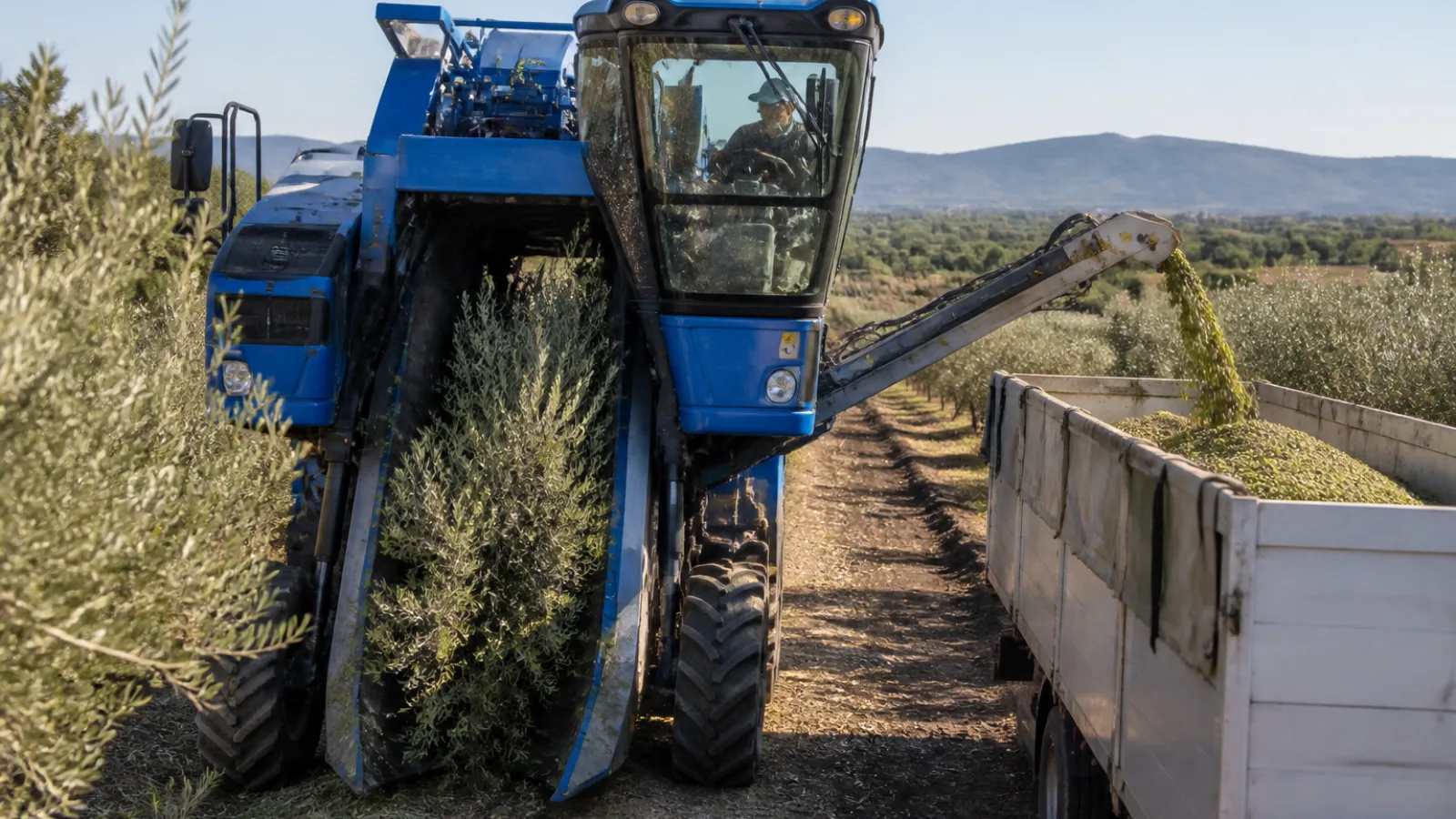
Harvesting olives efficiently is an engineering challenge because the fruit must be removed quickly, gently and at the correct stage of maturity. A commercial orchard may contain thousands of trees, and the harvest window can be limited by weather, fruit ripeness, labor availability and the need to deliver olives to a processing facility without unnecessary delay. Traditional hand picking can produce high selectivity, but it requires substantial labor and time. Modern mechanized olive harvesting addresses this challenge by combining controlled tree vibration, fruit collection, cleaning, temporary storage and unloading in one coordinated machine.
Among the most advanced solutions are over-the-row harvesters, including specialized equipment developed by manufacturers such as New Holland. These machines travel along a planted row and pass over or around the tree canopy. Rather than relying on workers to remove fruit branch by branch, they use engineered contact systems and vibration to detach olives, flexible catching surfaces to prevent ground losses, conveyors to move the crop and fans or separators to remove leaves and light debris.
The result is not simply a faster tractor attachment. It is an integrated mobile processing system that must manage vibration, hydraulics, power transmission, airflow, crop handling, operator visibility and vehicle coordination while moving through a living orchard.
How an Over-the-Row Olive Harvester Operates
An over-the-row olive harvesting machine begins its work when the operator aligns the machine with a prepared tree row. Guidance may be manual, assisted by cameras or supported by GPS-based positioning. The machine then advances at a controlled speed while its harvesting tunnel surrounds the upper and side portions of the tree canopy.
Inside the harvesting structure, rotating or oscillating elements contact flexible fruit-bearing branches. Their movement is designed to transmit enough energy to detach ripe olives without causing excessive breakage of branches or damage to the trunk. As fruit falls, a series of overlapping catching surfaces receives it. These surfaces are commonly made from flexible materials that adapt to the irregular shape of the canopy and reduce impact damage.
Collected olives are directed toward longitudinal conveyors. The conveyors move the crop from the harvesting zone to cleaning equipment and then into an onboard hopper or tank. Airflow systems remove leaves and small lightweight material before the olives enter storage. At the end of a harvesting cycle, the machine transfers the crop to a trailer or truck, often through a side-mounted or elevated unloading conveyor.
This sequence allows harvesting, primary separation and temporary storage to occur continuously. The machine does not normally replace the olive mill; washing, final cleaning, grading and oil extraction remain separate processing operations.
Tree Shaking, Vibration and Fruit Detachment
The engineering principle of mechanical detachment
Olives remain attached to branches through a stem connection that has a measurable detachment force. As fruit matures, this force generally changes. A harvesting system must apply sufficient dynamic force to overcome the connection while limiting the transmission of damaging loads into the tree structure.
Mechanical harvesters create this force through vibration and repeated contact. Important variables include vibration frequency, amplitude, contact duration, machine travel speed and the stiffness of the branches. Frequency describes how many oscillations occur in a given period, while amplitude describes the size of each movement. Increasing either variable can increase the energy transferred to the canopy, but more force is not automatically better. Excessive vibration may break shoots, strip leaves, damage bark or increase the number of immature fruits removed.
In practical operation, the machine is adjusted to the cultivar, tree architecture, fruit maturity and orchard conditions. The objective is a high removal rate with acceptable fruit and tree damage. The best settings are therefore a compromise between biological behavior and mechanical performance rather than a single universal frequency or amplitude.
Over-the-row contact versus trunk shaking
Trunk shakers grip the trunk or major structural branches and apply a larger oscillating force to the whole tree. They can be highly effective where trees have suitable trunks and open ground beneath the canopy, but they may require separate catching equipment or ground collection. Over-the-row machines work more directly on the fruit-bearing canopy and integrate collection into the harvesting pass. This makes them especially suitable for intensively planted, regularly pruned orchards designed for machine access.
Flexible Collection, Conveyors and Cleaning
Fruit collection is one of the most important differences between a modern olive harvesting machine and a basic shaker. Olives that fall onto bare soil can be contaminated, bruised or lost among leaves and stones. An over-the-row harvester uses flexible catching decks, skirts or overlapping panels to create a moving surface below the active canopy.
These collection surfaces must perform several tasks at once. They must follow uneven ground, avoid trapping branches, tolerate repeated impact and feed olives toward the conveyor without creating blockages. Their flexibility also reduces the drop height and impact energy experienced by the fruit.
Conveyor belts then move the olives through the machine. Belt speed is coordinated with travel speed and crop flow so that the system does not become overloaded. Cleated or textured belts may be used to control movement on inclined sections. Transfer points are designed to limit sharp drops, because bruising can accelerate deterioration before processing.
Cleaning normally begins with forced air. Fans generate an airflow that carries leaves and other light material away while denser olives continue along the product path. The airflow must be carefully balanced: too little air leaves excessive debris in the hopper, while too much can eject fruit or create unnecessary energy consumption. Some systems may also use screens, rollers or additional separation stages, depending on the machine design and crop conditions.
Hydraulics, Power Transmission and Machine Control
The hydraulic system is the machine’s principal source of controlled mechanical motion. Hydraulic pumps driven by the engine supply pressurized fluid to motors and cylinders that operate conveyors, fans, harvesting elements, steering functions, suspension components and unloading equipment. Hydraulic control allows the operator or electronic controller to vary speed and force continuously rather than relying only on fixed mechanical ratios.
Power transmission begins with the engine, which must provide enough output for propulsion and the simultaneous operation of harvesting, conveying, cleaning and unloading systems. The required power depends on tree density, terrain, travel speed, crop load and the design of the harvesting mechanism. It is not technically sound to assign one universal engine rating or field capacity to every olive harvester.
Modern machines use electronic control units to coordinate engine speed, hydraulic demand, belt movement, fan operation and harvesting intensity. Sensors can monitor pressure, temperature, conveyor speed, hopper level and machine position. Automatic adjustments help maintain a steady crop flow and reduce operator workload, although the operator remains responsible for alignment, speed selection, inspection and safe operation.
Onboard Storage and Unloading Into Transport Vehicles
Because harvesting is continuous, the machine needs temporary onboard storage. A hopper or tank receives cleaned olives after they pass through the collection and separation system. Its capacity must be large enough to avoid constant interruptions, but excessive storage adds weight and can increase soil compaction, fuel use and structural loads.
When the storage compartment reaches its operating level, the harvester unloads through a conveyor, elevator or side-discharge system. In high-throughput operations, a truck or trailer travels beside the harvester at a similar speed. This coordinated unloading method allows the harvesting machine to continue moving through the row instead of stopping to empty its tank.
Transport synchronization is a practical productivity issue. Poor coordination can cause waiting time, congestion at headlands or fruit exposure to heat. The transport vehicle must also be positioned to avoid contact with the harvester and to distribute the load without overloading one axle or section of the trailer.
Orchard Design Requirements
Over-the-row harvesting depends heavily on orchard geometry. Tree spacing must provide sufficient clearance for the machine’s width, harvesting tunnel and wheels. Row alignment should be as straight and consistent as possible, particularly when the machine operates at a steady speed. Irregular gaps, sharply angled rows and unmanaged branches reduce harvesting efficiency.
Pruning is equally important. Trees intended for mechanical harvesting are commonly trained to maintain a manageable canopy profile, adequate inter-row clearance and a branch structure that allows controlled contact. Excessively wide, low or irregular canopies may interfere with the machine or cause fruit to remain outside the effective harvesting zone.
Terrain also affects performance. Gentle, firm and well-drained ground is generally easier to harvest than steep, rocky or deeply rutted terrain. Slopes increase the risk of instability and can alter conveyor loading, tire traction and fruit distribution. Irrigation infrastructure, access roads, headlands and drainage channels must be planned so that they do not obstruct machine movement.
Manual Harvesting, Trunk Shaking and Over-the-Row Systems
Each harvesting method has a place in olive production. The correct choice depends on orchard design, labor costs, cultivar, terrain, fruit destination and required selectivity.
| Method | How it works | Main strengths | Important limitations |
|---|---|---|---|
| Manual harvesting | Workers hand-pick, comb or beat fruit onto nets and collect it manually. | High selectivity; suitable for irregular, steep or small orchards; limited machinery access required. | High labor requirement; slower field operation; exposure to labor shortages and rising harvest costs. |
| Trunk shaking | A clamp grips the trunk or structural branches and transmits vibration through the tree. | Fast detachment for suitable trees; can work with separate nets, sweepers or catch frames. | Requires compatible trunk geometry; may transmit high loads; collection may be a separate operation. |
| Over-the-row harvesting | A self-propelled machine travels over the row, shakes the canopy, catches fruit and conveys it to storage. | Integrated harvesting and collection; high potential throughput; reduced ground contact and labor dependency. | Requires suitable spacing, pruning and terrain; high capital cost; complex maintenance and operation. |
Measuring Productivity and Harvest Quality
Field productivity is often expressed in hectares per hour, but this figure is meaningful only when accompanied by orchard and operating conditions. Tree spacing, yield per tree, canopy shape, terrain, unloading time and travel distance all influence the result. A machine working continuously in a uniform orchard may perform very differently from the same machine in fragmented or irregular blocks.
Other important measures include fruit removal percentage, ground losses, fruit damage, leaf contamination, fuel consumption, labor hours per hectare and downtime. A high travel speed does not necessarily indicate superior performance if it increases unharvested fruit or damage. Likewise, a machine with a large hopper may still have low daily output if transport vehicles cannot keep pace.
Fruit quality is particularly important for oil production. Bruising, delayed transport and contamination can affect acidity, oxidation and sensory characteristics. Harvest planning should therefore connect field productivity with the receiving capacity and operating schedule of the olive mill.
Economic and Engineering Advantages
For large commercial orchards, mechanization can reduce dependence on seasonal labor and compress the harvest into a manageable period. Faster collection helps operators harvest near the target maturity window and deliver fruit to processing more consistently. Integrated catching and cleaning can also reduce ground contamination and the number of separate field operations.
The economic case depends on more than the purchase price. Owners must evaluate annual hectares harvested, expected machine utilization, fuel, maintenance, operator training, depreciation, financing, transport logistics and the cost of alternative labor. A sophisticated machine may be difficult to justify for a small or highly irregular orchard but economically attractive when shared among several large farms or operated by a specialist contractor.
Saudi Arabia, Al-Jouf and Irrigated Olive Production
Saudi Arabia has developed significant olive-growing activity, with Al-Jouf recognized as one of the country’s principal olive-producing regions. The region’s commercial orchards benefit from large-scale agricultural development, organized planting and irrigation systems that support tree growth in an arid environment. Modern agricultural machinery is increasingly relevant where orchard blocks are large enough to justify specialized equipment.
It is important to distinguish olive fruit production from olive oil production. Olives may be grown for oil, table consumption or both, and regional statistics can refer to planted area, tree numbers, fruit tonnage or processed oil volume. Claims about a specific percentage of national olive oil production or a total number of trees should be checked against current official or independently documented sources before publication.
In Al-Jouf, irrigation management is central to productivity. Water availability and scheduling influence canopy development, fruit load and the timing of maturation. Irrigation lines, access roads and orchard spacing must also be compatible with heavy machinery. As commercial farms expand, equipment such as specialized New Holland olive harvesting systems can support more predictable harvesting operations, provided the orchard has been designed for machine access and the machine is matched to local conditions.
Precision Agriculture and the Future of Olive Harvesting
Precision agriculture is making olive harvesting more measurable and controllable. GPS and guidance systems can help maintain row alignment, document harvested areas and reduce unnecessary overlap. Cameras and proximity sensors may assist with canopy detection, obstacle awareness and operator visibility. Load sensors can estimate harvested volume, while onboard software can record fuel use, operating time, engine load and machine faults.
Future systems are likely to combine machine vision, digital orchard maps and adaptive harvesting controls. A harvester could adjust speed or vibration intensity according to canopy density, fruit maturity indicators or detected gaps in the row. Remote fleet monitoring may allow managers to coordinate harvesters, trailers and service teams across large farms.
Fully autonomous harvesting remains technically demanding. Trees vary in shape, branches move unpredictably and terrain is not perfectly uniform. Safe autonomy will require reliable obstacle detection, redundant control systems, precise navigation and clear procedures for human intervention. The most realistic near-term development is assisted automation, in which the machine performs guidance, monitoring and optimization while a trained operator supervises the harvest.
Maintenance, Safety and Operational Limitations
Preventive maintenance is essential because harvesting machines operate in dusty, high-load conditions. Operators should inspect belts, flexible catching surfaces, bearings, hydraulic hoses, filters, fans, guards and fasteners before each shift. Hydraulic leaks require immediate attention, and conveyors should be cleared only after power has been isolated and stored energy released.
Safety procedures must cover moving harvesting elements, rotating shafts, pressurized hydraulics, elevated unloading conveyors and the interaction between the harvester and transport vehicles. Operators need appropriate training, clear visibility and communication protocols when working near trailers or ground crews. Machines should not be operated on slopes or surfaces beyond the manufacturer’s stated limits.
Mechanization also has limitations. It may not suit very old trees, steep land, mixed-age orchards or fruit intended for highly selective picking. Soil compaction, fuel consumption and capital costs must be managed through suitable tire pressures, controlled traffic, maintenance planning and realistic utilization targets.
Frequently Asked Questions
What is mechanized olive harvesting?
Mechanized olive harvesting uses powered equipment to detach olives and perform some combination of catching, conveying, cleaning, storing and unloading. The degree of automation varies from simple shakers to fully integrated over-the-row harvesters.
How does an over-the-row olive harvester collect fruit?
The machine travels along the tree row, applies controlled vibration or canopy contact, catches falling olives on flexible collection surfaces and transfers them by conveyor to cleaning equipment and an onboard hopper.
Are over-the-row harvesters suitable for every orchard?
No. They require compatible row spacing, canopy dimensions, pruning, alignment and terrain. Orchards with steep slopes, irregular trees or insufficient headland space may require trunk shakers, specialized attachments or manual harvesting.
Does mechanical harvesting damage olive trees?
Damage depends on tree structure, fruit maturity, machine settings and operator technique. Properly matched vibration and contact systems are designed to remove fruit while limiting broken branches, bark damage and excessive leaf loss.
What should a farm measure when evaluating an olive harvesting machine?
Useful measures include hectares per hour, fruit removal rate, ground losses, fruit damage, fuel use, labor hours, downtime, unloading time and the quality of fruit delivered to the mill.
Conclusion
Modern olive harvesting machines are examples of agricultural machinery engineering applied to a complex biological system. Their performance depends on the interaction of vibration, hydraulics, power transmission, flexible collection, airflow separation, storage logistics and electronic control. Over-the-row harvesters can deliver major productivity and labor advantages in large, well-designed orchards, but they are not universal replacements for every harvesting method.
For growers in Saudi Arabia and other expanding olive regions, the most successful approach is to treat mechanization as a complete system. Orchard layout, irrigation, pruning, transport, mill capacity, machine maintenance and operator training must be planned together. When those elements are aligned, mechanized olive harvesting can improve timeliness, reduce manual workload and support more consistent commercial production.